Include a byline with the reporter’s name and Direct Relief in the following format: "Author Name, Direct Relief." If attribution in that format is not possible, include the following language at the top of the story: "This story was originally published by Direct Relief."
If publishing online, please link to the original URL of the story.
Maintain any tagline at the bottom of the story.
With Direct Relief's permission, news publications can make changes such as localizing the content for a particular area, using a different headline, or shortening story text. To confirm edits are acceptable, please check with Direct Relief by clicking this link.
If new content is added to the original story — for example, a comment from a local official — a note with language to the effect of the following must be included: "Additional reporting by [reporter and organization]."
If republished stories are shared on social media, Direct Relief appreciates being tagged in the posts:
Twitter (@DirectRelief)
Facebook (@DirectRelief)
Instagram (@DirectRelief)
Republishing Images:
Unless stated otherwise, images shot by Direct Relief may be republished for non-commercial purposes with proper attribution, given the republisher complies with the requirements identified below.
Maintain correct caption information.
Credit the photographer and Direct Relief in the caption. For example: "First and Last Name / Direct Relief."
Do not digitally alter images.
Direct Relief often contracts with freelance photographers who usually, but not always, allow their work to be published by Direct Relief’s media partners. Contact Direct Relief for permission to use images in which Direct Relief is not credited in the caption by clicking here.
Other Requirements:
Do not state or imply that donations to any third-party organization support Direct Relief's work.
Republishers may not sell Direct Relief's content.
Direct Relief's work is prohibited from populating web pages designed to improve rankings on search engines or solely to gain revenue from network-based advertisements.
Advance permission is required to translate Direct Relief's stories into a language different from the original language of publication. To inquire, contact us here.
If Direct Relief requests a change to or removal of republished Direct Relief content from a site or on-air, the republisher must comply.
For any additional questions about republishing Direct Relief content, please email the team here.
In South Sudan, New Lifelines for Mothers and Babies
In a region where pregnant women still face dangerous journeys to give birth, emergency transportation and medical supplies are helping transform maternal care.
On September 21, a pregnant woman collapsed in a remote South Sudanese town, where reaching a hospital can mean hours of travel along roads that become nearly impassable in the rainy season.
But for the first time, help came on three wheels.
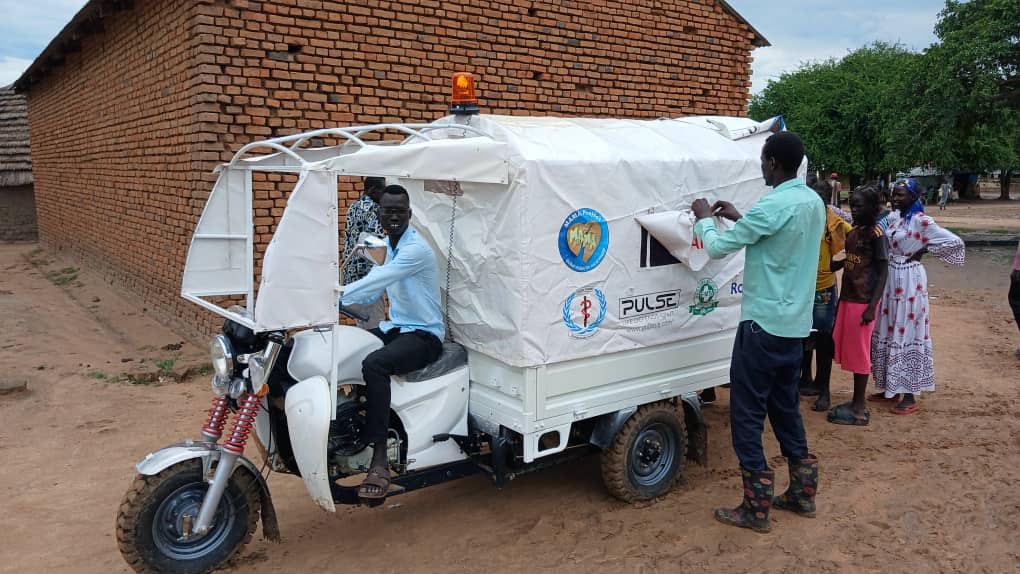
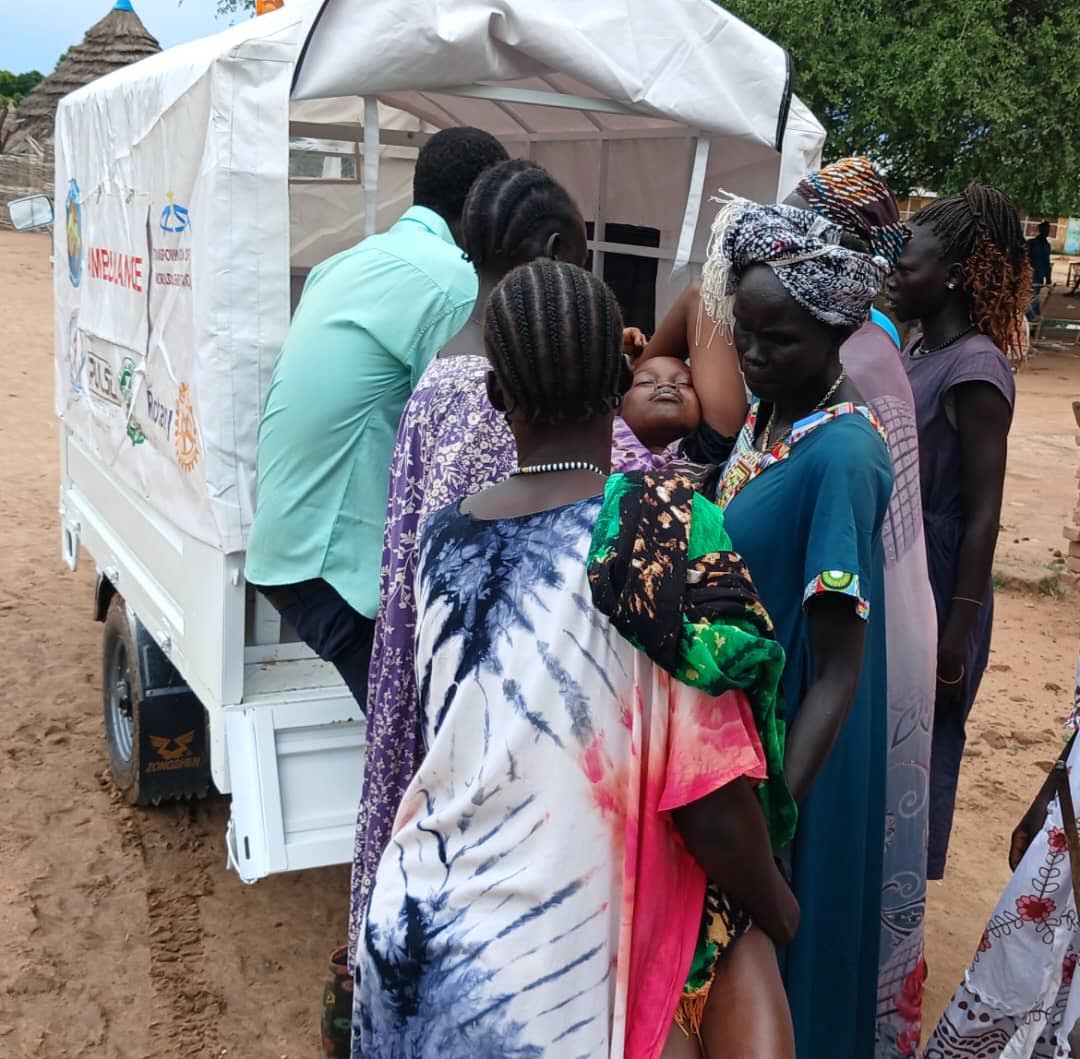
One of four newly launched motorcycle ambulances rushed the woman to Mother Teresa Hospital, marking a lifesaving first-day test of an emergency transport system designed to reach mothers in some of the country’s most isolated communities, including displacement camps.
South Sudan has the world’s highest estimated neonatal mortality rate, with roughly one in 25 babies dying within their first 28 days of life, according to United Nations Inter-agency Group for Child Mortality Estimation data published last year. South Sudan also has one of the world’s highest maternal mortality rates, with an estimated 692 deaths per 100,000 live births in 2023.
Against that backdrop, local health workers report a striking development.
“It has given us the good news up to now. We have no neonatal deaths and no deaths of the mother,” said Joseph Makuach, health coordinator for Transformation of the World in Christ, or TWIC, a local organization, which shares its acronym with the South Sudanese county of Twic, that coordinates medical services.
Working alongside a network of community clinics and Mother Teresa Hospital, the ambulance, which was funded by Direct Relief partner MAMA Project, transports women in labor and patients experiencing obstetric emergencies to facilities equipped to provide care. Recent shipments of midwife kits from Direct Relief have added essential supplies needed for safer deliveries.
Reaching Mothers Before It’s Too Late
TWIC, the nonprofit, supports six primary health care clinics serving rural communities and internally displaced people. The clinics are located in Ayak Makot, Biemnhom, Bombil, Akotong, Madou, and Gogrial West.
A new motorcycle ambulance in South Sudan helping pregnant women during childbirth. (Photo courtesy of MAMA)
The new fleet of motorcycle ambulances, built in Uganda, helps connect these communities with Mother Teresa Hospital and other local healthcare facilities operated by international NGOs. The vehicles have proved unexpectedly effective in difficult terrain. Unlike heavier ambulances, the motorcycles can navigate narrow, damaged roads and can be pushed free when they become stuck in mud.
When a woman needs emergency transport, community members contact TWIC staff, who coordinate with drivers and the receiving hospital. The vehicles have drivers and fuel available to respond.
The Supplies Behind Safer Deliveries
Transportation, however, is only part of the challenge.
Mother Teresa Hospital, the principal referral hospital in Twic County, has long struggled with shortages of essential medical supplies and adequately compensated health workers.
Direct Relief recently provided 15 midwife kits through TWIC’s partner network, with distributions to Mother Teresa Hospital, Lighthouse Hospital in Aweil, and nursing and midwifery partners associated with Juba Teaching Hospital.
A pregnant woman who collapsed in Turalei, Twic County, South Sudan, was safely transported to Mother Teresa Hospital aboard one of four newly launched three-wheeled motorcycle ambulances. The emergency response, which occurred on the day of the ambulances’ launch, demonstrated their potential to bring lifesaving care to women in remote villages and displacement camps, where difficult terrain and long distances can delay access to medical treatment. (Photo courtesy of MAMA Project)
The donated supplies include sterile gauze, gloves, umbilical cord clamps, disinfectants, and medicines such as magnesium sulfate and misoprostol, used in managing complications of pregnancy and childbirth. Together, the materials help health workers maintain hygienic conditions and respond to emergencies.
Dr. Luka Matik, director of Mother Teresa Hospital, said the supplies have improved conditions for mothers and newborns during both vaginal and cesarean deliveries.
“Safety and hygiene, they ensure safety for the mothers and babies,” Matik said, explaining that clean delivery practices reduce the risk of infections.
Matik said deliveries at the hospital have increased since the kits arrived, an indication, he believes, that women are gaining confidence in the care available.
“If a mother comes and delivers and sees she’s well taken care of, she will go ahead and spread the word,” he said.
In October, the hospital performed 20 cesarean sections, including procedures for women referred from surrounding health facilities.
The impact of the donated supplies extends to Aweil, in neighboring Northern Bahr el Ghazal state. At Lighthouse Hospital and its outreach centers, health workers recorded 180 deliveries resulting in 182 newborns in October, according to a report submitted to Direct Relief. The facilities also provided antenatal care to 480 clients and referred five women to Aweil Civil Hospital for cesarean sections. No maternal deaths were recorded during the month.
For Teresa Paul, a midwife at Lighthouse Hospital, the difference is apparent when women arrive in labor, particularly at night.
“Before the kits arrived, we often struggled with shortages of gloves, plastic sheets, cord clamps and chlorhexidine,” she said in a statement included in the hospital’s report. “When a mother came into labor at night, and supplies were not available, it was heartbreaking.”
“Now we can reassure mothers that essential delivery supplies are ready.”
For some patients, the benefits are also financial. Mary Abuk Garang, a 32-year-old mother who received care at Lighthouse Hospital, said she arrived without the supplies needed for childbirth.
“I came with nothing, but I received what I needed for my delivery,” she said in a testimonial provided by the hospital.
Dr. Repent Khamis George, principal of the Juba College of Nursing and Midwives, said midwife kits were distributed to three primary health care centers around Juba, the nation’s capital, where staff welcomed supplies that are often difficult to obtain.
Progress Amid Persistent Shortages
Despite the reported improvements, formidable challenges remain.
Matik said Mother Teresa Hospital needs additional surgical nurses, disinfectants, cleaning materials, intravenous fluids, catheters, and basic linens. Some health workers have gone months without government-funded incentive payments, placing additional pressure on colleagues supported by TWIC.
Even as these personnel challenges and other stark issues remain, Makuach, TWIC’s health coordinator, assessed recent developments in lives saved.
“Our situation is not like before,” he said.
Since 2025, Direct Relief has provided $3.2 million in medical aid to support the health work of Transformation of the World in Christ in South Sudan.
Giving is Good Medicine
You don't have to donate. That's why it's so extraordinary if you do.
Hear From Direct Relief
Get stories, emergency updates, and humanitarian impact delivered to your inbox.