Include a byline with the reporter’s name and Direct Relief in the following format: "Author Name, Direct Relief." If attribution in that format is not possible, include the following language at the top of the story: "This story was originally published by Direct Relief."
If publishing online, please link to the original URL of the story.
Maintain any tagline at the bottom of the story.
With Direct Relief's permission, news publications can make changes such as localizing the content for a particular area, using a different headline, or shortening story text. To confirm edits are acceptable, please check with Direct Relief by clicking this link.
If new content is added to the original story — for example, a comment from a local official — a note with language to the effect of the following must be included: "Additional reporting by [reporter and organization]."
If republished stories are shared on social media, Direct Relief appreciates being tagged in the posts:
Twitter (@DirectRelief)
Facebook (@DirectRelief)
Instagram (@DirectRelief)
Republishing Images:
Unless stated otherwise, images shot by Direct Relief may be republished for non-commercial purposes with proper attribution, given the republisher complies with the requirements identified below.
Maintain correct caption information.
Credit the photographer and Direct Relief in the caption. For example: "First and Last Name / Direct Relief."
Do not digitally alter images.
Direct Relief often contracts with freelance photographers who usually, but not always, allow their work to be published by Direct Relief’s media partners. Contact Direct Relief for permission to use images in which Direct Relief is not credited in the caption by clicking here.
Other Requirements:
Do not state or imply that donations to any third-party organization support Direct Relief's work.
Republishers may not sell Direct Relief's content.
Direct Relief's work is prohibited from populating web pages designed to improve rankings on search engines or solely to gain revenue from network-based advertisements.
Advance permission is required to translate Direct Relief's stories into a language different from the original language of publication. To inquire, contact us here.
If Direct Relief requests a change to or removal of republished Direct Relief content from a site or on-air, the republisher must comply.
For any additional questions about republishing Direct Relief content, please email the team here.
“We Are the Women We Serve”: Inside Birth Detroit’s Mission to Support Maternal Care
Birth Detroit opened a Black-led birth center in 2025, the only independent birthing center within the city. Their staff assists low-risk patients and their families in preparing for and delivering healthy babies in a safe and culturally relevant space.
DETROIT — At a new clinical health site on the city’s northwest side, clients are greeted with love and kindness in a serene space, one where birthing women are surrounded by a support system of certified professionals.
This is the place where 17 babies were born in the past year. Their names are displayed on a family tree at the entrance of a building where a team of proud midwives greets guests each day.
Birth Detroit opened the Black-led birth center in 2025. It’s the only independent birthing center within the city. Their staff assists low-risk patients and their families in preparing for and delivering healthy babies in a safe and culturally relevant space. As the state battles high infant mortality and maternal mortality rates, health advocates say increasing access to midwifery services and culturally competent care can improve conditions.
Birth Detroit was founded in 2018 and became an operating nonprofit in 2020. During the height of the Covid-19 pandemic, staff and volunteers offered childbirth education and prenatal classes for Detroiters. They worked in community spaces, including a care clinic on Detroit’s northwest side, and prioritized their services around the needs of Black women.
“Home Away from Home”
The Birth Detroit birthing center has full bathrooms with walk-in showers for women to labor in peace (Photo by Birth Detroit).
The swing suite is designed to be a flex space for labor and delivery as well as prenatal health needs (Photo by Birth Detroit).
Colorful murals and artwork from local artists are placed throughout the birth center to help families feel seen and represented (Photo by Birth Detroit).
Certified nurse midwives work with patients in an exam room at Birth Detroit’s independent birth center (Photo by Birth Detroit).
The birth suite at Birth Detroit’s birth center is designed to be comfortable and cozy so that mothers can feel at peace during the labor process (Photo by Birth Detroit).
A deep tub in the birth suite has a view of an affirmation wall to give mother’s positive messages while laboring (Photo by Birth Detroit).
Birth Detroit completed it’s first independent birth center in Detroit in 2025 (Photo by Birth Detroit).
The community room at Birth Detroit’s birth center is peaceful and encourages connection among families (Photo by Birth Detroit).
The birth center has two birthing suites, a primary space with a deep free-standing tub, a full bathroom with a wall-tiled shower, and a large bed adorned with comfortable pillows.
On a recent tour, Birth Center Director Angela Foster pointed to a corkboard wall across from the bed and above the tub that highlighted words of affirmation. Families are encouraged to bring photographs and their own words of affirmation to pin throughout the birthing process to build a sense of strength and security.
The second birthing suite has a convertible day bed, space for a temporary tub, a full bathroom, and a kitchenette. Birth center staff say they have the space for two families to birth at the same time through the two suites, and often use the spaces to build comfort with families as they prepare for the birthing day.
“We know that families labor and do well at home, so we want this to feel like home away from home,” Foster said. “We want them to feel like this is their space.”
How Midwifery Services Combat Black Infant and Maternal Mortality Rates in Michigan
For years, healthcare professionals and advocates have worked to address the infant mortality rate in Michigan. In 2020, the infant mortality rate for the state was 6.8 per 1,000 live births. By 2025, the rate decreased to 6.3.
Birth Center Equity, a nonprofit that aims to make birth center care an option in every community, works with over 70 birth centers led by Black, Indigenous, and people of color across the U.S. The nonprofit has found that culturally relevant care and access to midwifery services for low-risk births have produced comparable and better maternal and infant outcomes. This includes fewer cesarean surgeries, fewer low-birth-weight babies, fewer NICU transfers, and more mothers participating in breastfeeding. The organization, in collaboration with Direct Relief, awarded $250,000 total to five birth centers across the U.S., including Birth Detroit, which is meeting a critical need for families.
According to the State’s Department of Health and Human Services, there are significant differences among racial groups. In 2020, the infant death rate of white babies was 5 per 1,000 live births, while for Black babies the rate was 13.8. In 2024, the white infant death rate decreased to 4.3, while the Black infant death rate increased to 14.9.
Foster is a certified nurse midwife at Birth Detroit. She said the nonprofit is building relationship-based care through the skillset of midwifery to offset the disproportionate Black, Indigenous, and people of color infant mortality rates.
“Culturally competent care matters,” Foster said. “It matters when you walk in the room and (whether) your provider can relate to you. We are the women we serve.”
Connecting Community and Clinical Excellence in Detroit’s Petoskey-Otsego Neighborhood
Health advocates are also working to confront the state’s maternal health crisis through group prenatal care and collaborative healthcare systems. According to the Center for Health and Research Transformation at the University of Michigan, there were 19.1 maternal deaths per 1,000 live births in 2022. Most were preventable, and Black women were 2.2 times more likely to die from pregnancy-related causes than white women.
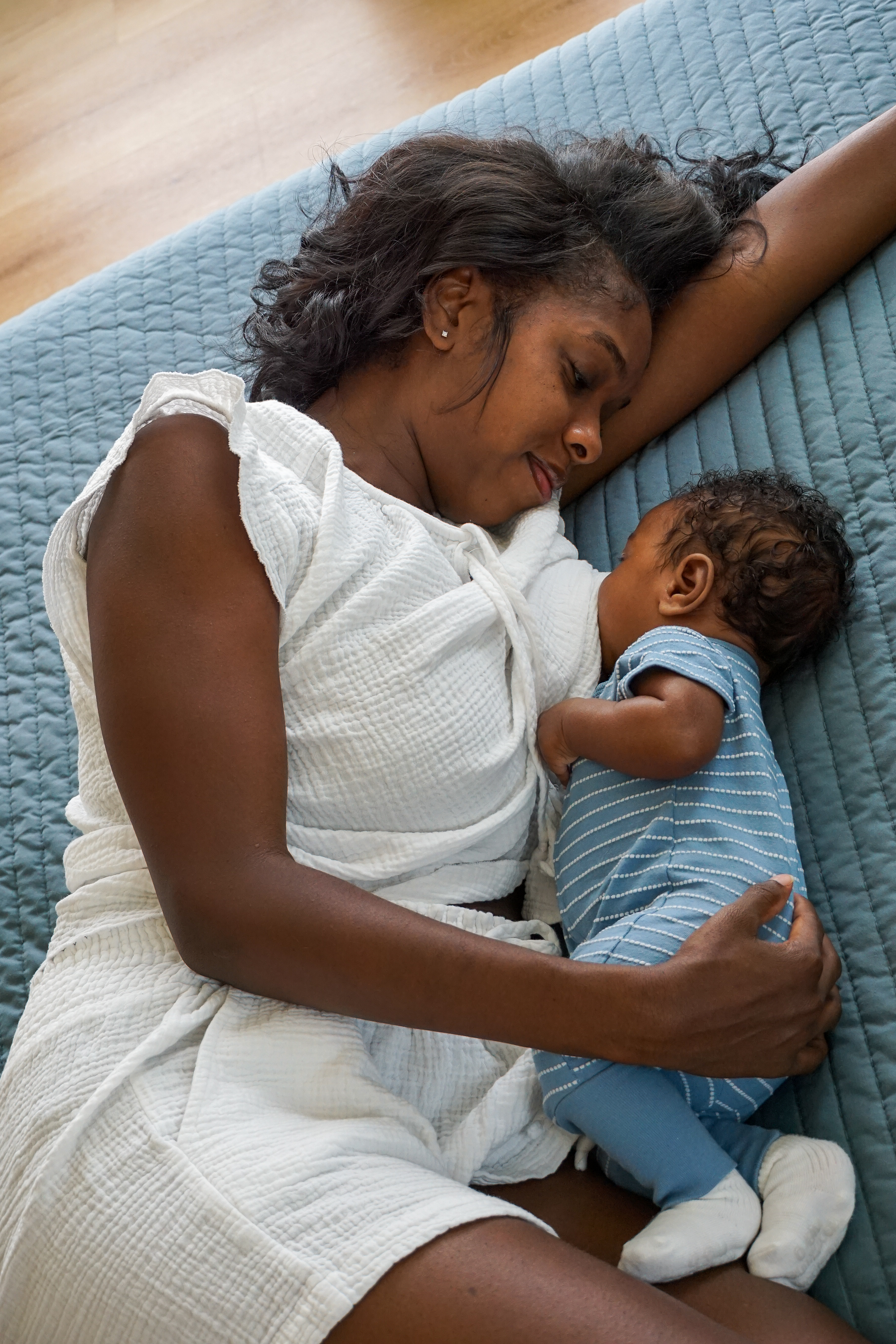
A mother and baby bond through breastfeeding at Birth Detroit’s first independent birth center on Detroit’s west side. “We know that families labor and do well at home, so we want this to feel like home away from home,” said Birth Detroit’s Angela Foster. “We want them to feel like this is their space.” (Birth Detroit photo)
“Midwives are the gap between the maternal health crisis and fixing the maternal health crisis,” said Vanessa Landrum, a certified nurse midwife. “Because of the way that we care for our clients, because of the way that we love our clients.”
Landrum founded the center’s EMERGE program, which supports individuals through the emotional, physical, and identity transitions of womanhood and motherhood. Landrum, also a Board Certified Psychiatric-Mental Health Nurse Practitioner, said that it’s important for the clients to feel joy and camaraderie as they develop through the birthing process.
Birth center staff said it was important that the center be located within the city limits to further support Detroit families. Within the city, the BIPOC infant mortality rate is 18.8, and is disproportionate to their white counterparts’ rate of 6.6.
Birth Detroit leadership said they chose to build the center in Detroit’s Petoskey-Otsego neighborhood, away from downtown and within a residential area. It’s also just 2.5 miles from the nearest hospital.
The midwives say they do “warm hand-offs” should a client need further medical care. Four out of five major hospital systems within the Detroit-metro area also accept midwife credentials.
Building a Foundation of Safety, Love, and Holistic Care for Detroit Families
“When you see someone who looks like you, the first thing that comes to mind is trust,” said Vanessa Landrum, a certified nurse midwife. “We’re in this community; we’re in Detroit proper. There’s a hospital right down the street that people can choose to go to, but they choose to come to us instead.”
While Detroit’s BIPOC infant mortality rate is high, Wayne County does not have the highest infant mortality rate in the state. According to Census data, Wayne County ranks third, following Saginaw County, whose non-white population is 65% and has an infant mortality rate of 11; and Isabella County, whose non-white population is 18% and the infant mortality rate is 11.2.
The center staff prioritizes community gathering and built-in support.
The center has an open-concept space with a galley kitchen wall and a large island for people to gather while they eat. On the opposite wall is a comfy fireplace and seating, where staff host group prenatal and birthing classes.
The essence of gathering, or coming together for fellowship, is strongly encouraged.
“Our core values are safety, love, trust, and justice,” said Dr. Elikem Amable-Brumfield. “It’s extremely important to make sure that we’re taking into account the psyche of the mom. And that’s part of the mental health that we evaluate throughout the entire pregnancy to figure out what does your support look like.”
Amable-Brumfield is a nurse practitioner and certified nurse midwife. She works at both the center and at the nearby Henry Ford Hospital. At Birth Detroit, Amable-Brumfield said she has longer appointment times with patients during their well-woman and prenatal visits, which allows her to get to know her patients and understand their day-to-day experiences.
“What you see in this building, how you see us all interact with one another, it’s genuine,” Amable-Brumfield said. “When we take care of one another, we’re able to grow. We’re able to pour into one another, so we’re able to pour into the families that we serve.”
Most of the staff and midwives at Birth Detroit are mothers themselves. While they all say they wish the center had been open during the time of their individual birthing processes, they say they are glad to be able to provide support for other Detroiters.
“We are the women we serve, and I don’t think it can be any more authentic or any more genuine than that,” said Amable-Brumfield.
In collaboration with Birth Center Equity, Direct Relief provided a $50,000 grant to Birth Detroit to support midwives working with families in Detroit.
Giving is Good Medicine
You don't have to donate. That's why it's so extraordinary if you do.
Hear From Direct Relief
Get stories, emergency updates, and humanitarian impact delivered to your inbox.